Monday.com just published a guide on capacity management for scalable growth. It presents four strategies for managing resources as you scale: lag (add capacity after demand increases), lead (build capacity ahead of demand), match (adjust incrementally), and adjustment (shift resources in real-time).
The article is well-written. The strategies are logical. The software features look useful.
But there's a problem hiding in plain sight: every strategy assumes you already know what capacity means for your team. And most creative teams don't.
Not because they lack dashboards or metrics or visibility tools. But because they've never had the conversations to define what they're measuring in the first place.
You can't scale undefined capacity. You just scale confusion.
What Monday.com Gets Right
Before we dig into what's missing, let's credit what the Monday team got exactly right.
Their real-world example is perfect: a mid-size marketing team starts with a shared spreadsheet. Team members input weekly availability and deliverables. "Within days, the picture is clearer: Some people are near burnout, others have excess capacity."
Yes. This is the right starting point. Making invisible work visible through simple collaboration.
They also emphasize team wellbeing and burnout prevention. Their focus on "aligning resources with workload demands" to improve both execution and employee engagement is the right goal.
And they're correct that visibility matters. You can't manage what you can't see.
The issue isn't their advice. It's where they start.
The Hidden Assumption
All four of Monday's strategies—lag, lead, match, and adjustment—require inputs you probably don't have:
- What's your current capacity?
- What's your current demand?
- How do you measure capacity use in a way that means something?
Their guide presents these as known quantities you can plug into formulas. But for creative teams, knowledge workers, and professional services, they're not.
Monday mentions one symptom that reveals the gap: "forecasting feels like guesswork."
That's not a tool problem. That's a definition problem.
Why Capacity Planning Strategies Break Without Definition
Let's walk through what happens when you apply Monday's strategies without defining the work first.
Lag Strategy: "Add capacity after demand increases"
This sounds conservative and financially responsible. Wait until you're actually overloaded, then hire.
But how do you know when demand has increased?
If a client's "monthly reporting" quietly evolves from a simple task to a complex multi-system data pull with three revision rounds, does that show up as increased demand?
Not in your hours. Your team member is still working the same 40-hour week. They're just more stressed, less satisfied, and wondering why this "routine" task now consumes an entire day.
This is drift—when work expands without anyone noticing. And it's invisible unless you've defined what the work should cost in the first place.
Lag strategy only works if you're measuring something meaningful. Hours logged don't capture effort. And effort isn't visible unless your team has defined it together.
Lead Strategy: "Build capacity before demand hits"
This requires forecasting. Monday recommends analytics and monitoring to predict what's coming.
Forecast what, exactly?
If your team hasn't agreed on what a unit of work costs, you can't extrapolate anything. You're projecting fantasy numbers onto spreadsheets.
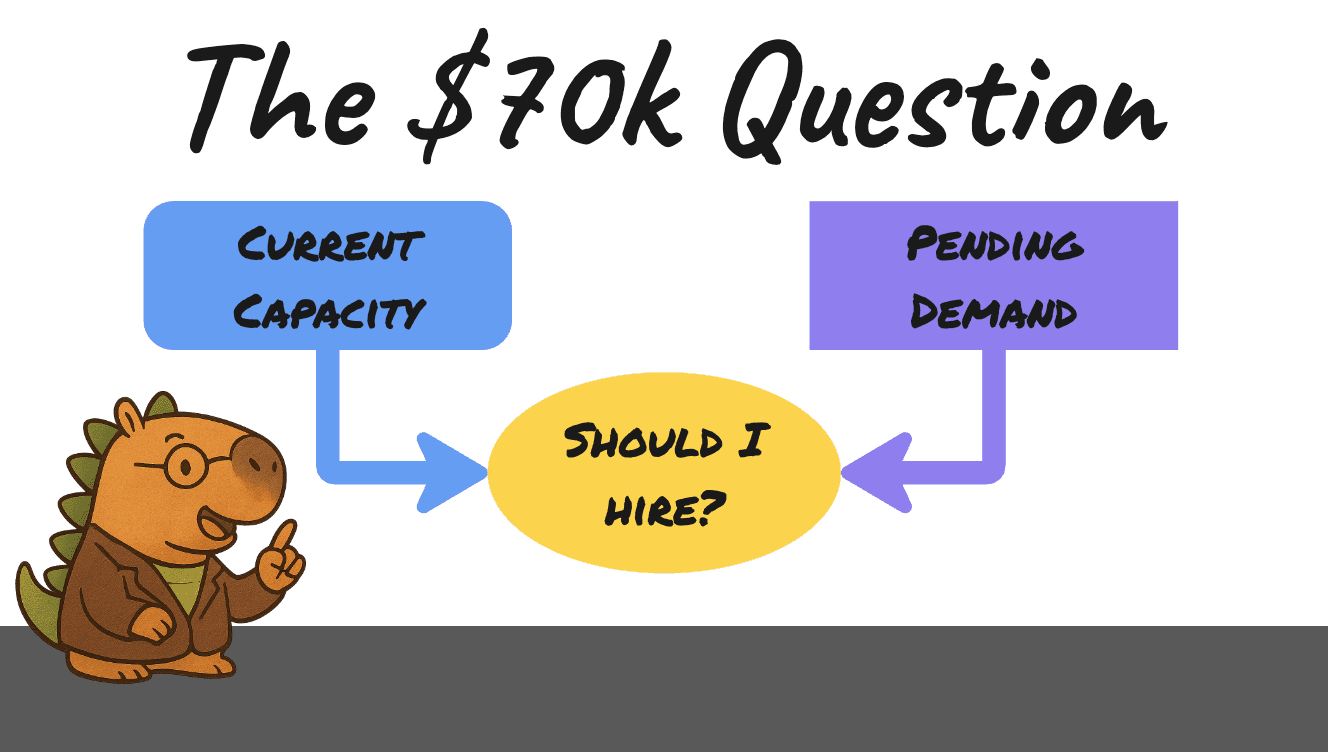
The result: you either hire too early (wasting $70K on someone who doesn't have enough work yet) or hire too late (losing your best people to burnout). Both because you were measuring the wrong thing.
Match Strategy: "Adjust capacity incrementally as demand shifts"
Beautiful in theory. Lean, just-in-time resource management.
In practice, matching requires knowing:
- What work your team actually does (not just project names, but the repeatable tasks)
- How demanding that work is (not hours, but cognitive load)
- Who's doing what and why
Without these answers, "matching" is impossible. You're guessing at both sides of the equation.
Adjustment Strategy: "Shift resources in response to real-time signals"
Real-time dashboards are fantastic. If the underlying data means something.
But if your capacity number just means hours logged against a target, you're watching noise. That designer at 80% booked might be coasting or might be drowning. You can't tell from the number.
Someone at 80% doing routine work is fine. Someone at 80% doing high-complexity strategy across six clients is one bad week from quitting. The dashboard shows the same number for both.
| Strategy | What it promises | Why it breaks without definition |
|---|---|---|
| Lag | Add capacity after demand increases | Drift hides demand growth when you only count hours |
| Lead | Build capacity before demand hits | You can't forecast work your team hasn't defined |
| Match | Adjust incrementally as demand shifts | You're guessing at both sides of the equation |
| Adjustment | Shift resources on real-time signals | The same number hides who's coasting and who's drowning |
What's Actually Missing
Monday's article recognizes that capacity problems create predictable symptoms:
- Missed deadlines despite strong effort
- Frequent task-switching between unrelated projects
- Lack of clear ownership in project planning
- Forecasting feels like guesswork
- Strategic goals aren't linked to daily execution
These symptoms are accurate. But the solution isn't better software for tracking undefined work.
The solution is having the conversations your team keeps avoiding.
Conversation #1: What work do we actually do?
Not project names. Not client names. The repeatable building blocks that fill your team's week.
"Client onboarding." "Monthly reporting." "Strategic planning session." "Campaign creative development." "Ad-hoc revisions."
Until you name these units of work, you can't measure them. You're just counting hours against projects that could contain anything.
This conversation is uncomfortable because it exposes how much your work has drifted from what you thought you were selling. But it's foundational.
Conversation #2: How demanding is this work, really?
Not how long it takes. How much it costs in terms of cognitive load, emotional labor, complexity.
Is monthly reporting a 3 or a 7 compared to everything else you do?
The team scores it together. Not management handing down estimates, but the people doing the work agreeing on what it actually takes.
Now when you look at capacity, you're not just seeing "Sarah has 32 hours scheduled." You're seeing "Sarah is carrying 47 effort points against a 40-point capacity." That's a signal you can act on.
Conversation #3: Is your star performer ready for more?
Your senior designer is crushing it. Always delivers, never complains, makes it look easy.
Should you give them more work? A new client? A bigger scope?
Most managers guess. They go with gut feeling or wait for the person to ask.
But if you've defined work units and effort scores, you can actually look at what someone's carrying and see the gap between current state and capacity. You can see if there's room. And more importantly, you can see if the work you'd add aligns with where they want to grow.
This conversation turns capacity into career development, not just workload management.
Conversation #4: When do we need to hire?
This is where the $70K question gets answered with data instead of panic.
If your team has been running at 85%+ of capacity for two months, and the work you're turning down is profitable and repeatable, you have a case for hiring.
If one person is overloaded but the team average is 70%, you have a distribution problem, not a capacity problem.
You can't have this conversation productively without defining what you're measuring first.
Conversation #5: Does this still feel right?
Capacity isn't static. Work evolves. Clients change. Team members grow.
What felt balanced three months ago might not feel right now. But most teams never explicitly check.
"Does this distribution still make sense?" should be a quarterly conversation, not an annual crisis.
When you've defined the work and scored the effort, this conversation becomes collaborative instead of defensive. You're looking at the same data, discussing the same reality.
A Different Starting Point
Monday's guide says "capacity management doesn't have to be complex. It just has to be visible."
Close. But not quite.
Capacity management doesn't have to be complex. But it does have to be defined before visibility matters.
Here's the sequence that actually works:
Step 1: Define before you measure
Get your team in a room. Ask: "What are the 10-20 things we do repeatedly?"
Not projects. Building blocks. The tasks that consume your weeks.
Write them down. Don't worry about being comprehensive. You'll refine this. The goal is to start seeing work as discrete units instead of an undifferentiated mass of "busy."
This is your work catalog. It's the foundation everything else builds on.
Step 2: Score the effort collaboratively
For each work unit, ask: "How demanding is this when it shows up in our week?"
Use a simple scale. 1-10 works. Fibonacci (1, 2, 3, 5, 8, 13) works if your team knows it from software development.
The key: let the people doing the work score it. Discuss the disagreements. If someone thinks monthly reporting is a 3 and someone else thinks it's a 7, you've just discovered that the work has quietly expanded. That's valuable information.
This is effort scoring, and it's what makes capacity planning actually work for creative teams.
Step 3: Look at the distribution
Now that you have work units and effort scores, look at who's carrying what.
Map each person's current assignments. Add up the effort. Is it balanced? Is it intentional?
This is where the real conversation happens. Why does Sarah have six clients while Tom has three? Is it fair? Is it strategic? Or did it just happen?
When the answer is "it just happened," you don't have capacity management. You have an accumulation of reactions.
Step 4: Now the strategies work
Only after these three steps do Monday's four strategies become useful.
Now "lag" versus "lead" actually means something because you're measuring effort, not just hours. Now a dashboard can tell you something true because the underlying data reflects reality.
Now when you look at capacity use, you're seeing cognitive load, not time logged. Now when you forecast, you're projecting defined work units, not vague assumptions.
The strategies aren't wrong. They're just downstream from the hard work most teams haven't done yet.
What Scalability Really Requires
Monday is right that capacity management enables scalable growth. But scalability doesn't come from choosing the right strategy.
It comes from alignment.
Getting your team on the same page about what work you do, how demanding it really is, and whether the current distribution makes sense. That's the foundation.
Without that foundation, all four strategies are just different flavors of guesswork. With it, the right approach becomes obvious.
You can't scale what you haven't defined. But once you've had the conversations—once everyone sees the same picture—scaling becomes straightforward.
The work catalog tells you what you do. The effort scores tell you what it costs. The distribution shows you where the gaps are. And the conversations keep everything aligned as you grow.
That's when the dashboards start mattering. That's when real-time adjustments make sense. That's when you can confidently choose between lag and lead strategies because you actually understand what you're managing.
The Real Complexity
Here's what Monday's "it doesn't have to be complex" framing misses: the hard part isn't the tool or the strategy.
The hard part is getting people to agree on what work actually costs.
Managers have to admit they've been underestimating. Team members have to be honest about who's stretched and who's coasting. And everyone has to put numbers on things that feel unquantifiable.
It's uncomfortable. It takes time you could spend on billable work. It requires psychological safety and trust.
But it's the only way to build capacity management that actually scales.
Tools make it easier to visualize what you've defined. Strategies help you decide how to respond. But if you haven't defined the foundation, you're just building on sand.
Start With the Conversations
If you're looking at Monday's four strategies and feeling uncertain which to choose, that uncertainty is the signal.
Don't pick a strategy yet. Start with the conversations.
What work do we actually do? How demanding is it? Who has what, and why? Is our star ready for more? When do we need to hire? Does this still feel right?
These aren't easy questions. But they're the right ones.
Monday's tools might help you track the answers. Their strategies might help you respond. But you have to ask the questions first.
Capacity planning that scales doesn't start with software. It starts with alignment.
Quick answers
Why won't capacity planning strategies scale for creative teams?
Every strategy—lag, lead, match, and adjustment—assumes you already know what capacity means for your team, and most creative teams don't. Not because they lack dashboards or metrics, but because they've never had the conversations to define what they're measuring in the first place. You can't scale undefined capacity; you just scale confusion.
What conversations should come before choosing a capacity strategy?
Five, in order: What work do we actually do? How demanding is it, really? Is your star performer ready for more? When do we need to hire? And does this still feel right? These name the repeatable building blocks, score their effort by cognitive load rather than hours, and turn capacity into a shared, collaborative picture instead of a manager's guess.
What sequence actually makes capacity planning work?
Define before you measure—get your team in a room and name the 10-20 things you do repeatedly to build a work catalog. Then score the effort collaboratively, letting the people doing the work rate each unit and discussing the disagreements. Then look at the distribution to see who's carrying what and whether it's intentional. Only after those three steps do the lag, lead, match, and adjustment strategies become useful, because now the underlying data reflects reality.
Ready to have the conversations your team keeps avoiding? We created a guide to help: 10 Capacity Conversations Your Team Isn't Having — the strategic foundation that makes every tactical approach actually work.
Or if you want to see how effort-based capacity management works in practice: Try Capysaurus free