Every agency owner knows the feeling. Your team is stretched thin. Deadlines are slipping. Your best designer just mentioned they're "exploring options." And somewhere in the back of your mind, a voice is screaming: "We need to hire someone. Yesterday."
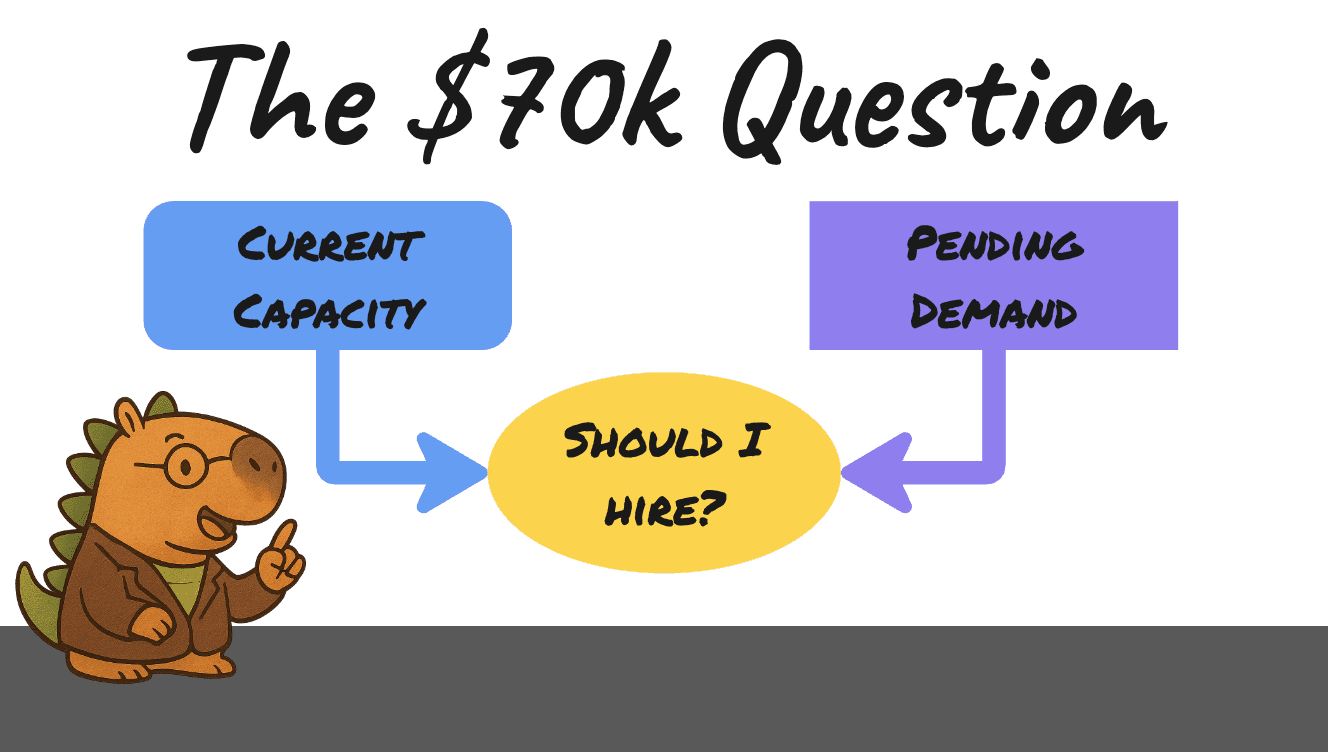
But hiring is expensive. Really expensive. That mid-level designer you're thinking about? By the time you factor in salary, benefits, equipment, onboarding time, and the inevitable learning curve, you're looking at a $70K+ commitment in the first year alone.
So you hesitate. You wonder. You second-guess.
Hire too early, and you've got an expensive team member twiddling their thumbs while you scramble to find enough work to justify their salary.
Hire too late, and your top performers are already polishing their resumes, your quality is slipping, and that reputation you've built over years is eroding project by project.
The Problem with "Going with Your Gut"
Most agency owners make hiring decisions the same way they make most decisions: a mix of gut feeling, spreadsheets, and whatever metric was mentioned in the last podcast they listened to.
But here's the thing about gut feelings: they're notoriously bad at predicting the future when multiple variables are at play.
Your gut might tell you that Sarah seems stressed, but it can't tell you:
- Is she at 90% capacity or 110%?
- Is this a temporary spike or a sustained pattern?
- If you moved one client, would it solve the problem?
- Is the solution hiring, or is it redistributing work?
The Capacity Framework
This is where capacity management comes in. Not time tracking (nobody wants more of that), but effort tracking - understanding how much cognitive and creative weight your team is carrying.
Think of it like this: You wouldn't run a manufacturing plant without knowing how loaded your machines are. Why run a creative agency without knowing how loaded your team is?
The key metrics you need:
1. Role Capacity vs. Actual Load
Every role has a capacity - the sustainable amount of effort they can produce week over week. A senior designer might have a capacity of 40 effort points per week. But if they're consistently assigned 48 points of work, that's not "hustle culture" - that's a ticking time bomb.
2. Capacity Used vs. Target
What percentage of capacity is being used? The sweet spot for creative work is usually 75-85%. Below that, you're overstaffed. Above that, you're burning people out.
3. Trend Over Time
One busy week isn't a crisis. But three months of 90%+ capacity use? That's a pattern, and patterns predict futures.
The Decision Framework
So when DO you actually need to hire? Here's the framework:
Consider hiring when:
- Average team capacity use exceeds 85% for 8+ weeks
- Multiple team members are consistently above capacity
- Work is being turned away or delayed due to capacity constraints
- The work you're doing is profitable and repeatable (not a one-time spike)
Don't hire yet if:
- The overload is concentrated in 1-2 people (redistribute first)
- It's a seasonal spike you can predict and plan for
- You haven't optimized your work distribution
- The extra work isn't profitable enough to justify the role
Consider a different solution if:
- The work type is inconsistent (contractors might be better)
- The overload is skill-specific, not volume-specific (upskill or hire differently)
- Client concentration is too high (risky to hire for one client's work)
| Signal | What to do |
|---|---|
| Team load above 85% of capacity for 8+ weeks, multiple people over capacity, profitable work being turned away | Consider hiring |
| Overload concentrated in one or two people, a predictable seasonal spike, or distribution not yet optimized | Redistribute or wait, don't hire yet |
| Inconsistent work type, a skill-specific gap, or one client driving the overload | Consider a different solution (contractors, upskilling) |
Making It Actionable
Here's the thing: most agencies don't have this data. They have timesheets (maybe), they have gut feelings (definitely), and they have a vague sense that "things are busy."
That's why we built Capysaurus - to give you the visibility you need to make confident decisions. Not more busywork for your team, not surveillance, but insight.
Because that $70K question deserves a $70K answer. And "I think so" isn't it.
Quick answers
How do you know when it's actually time to hire?
Look for a sustained pattern, not a single busy week. The signal to seriously consider hiring is when average team load stays above 85% of capacity for eight or more weeks, when multiple people are consistently over capacity, and when profitable, repeatable work is being turned away because there aren't enough hands. One stressful week is noise; three months of the same is a pattern, and patterns predict futures.
When should you redistribute work instead of hiring?
When the overload is concentrated in one or two people, redistribute first. Hiring is the wrong move if it's a predictable seasonal spike you can plan for, if you haven't optimized how work is shared across the team, or if the extra work isn't profitable enough to justify the role. A different solution - contractors or upskilling - fits better when the work type is inconsistent or the gap is skill-specific rather than volume-specific.
Why is hiring on gut feeling risky?
Gut feelings are notoriously bad at predicting the future when several variables are in play. Your instinct might tell you someone seems stressed, but it can't tell you whether they're at 90% or 110% of capacity, whether it's a temporary spike or a sustained pattern, or whether moving a single client would solve the problem. Effort data answers those questions so a $70K decision rests on more than "I think so."
Want to know where your team actually stands? Start your free trial and see your capacity in under 30 minutes.