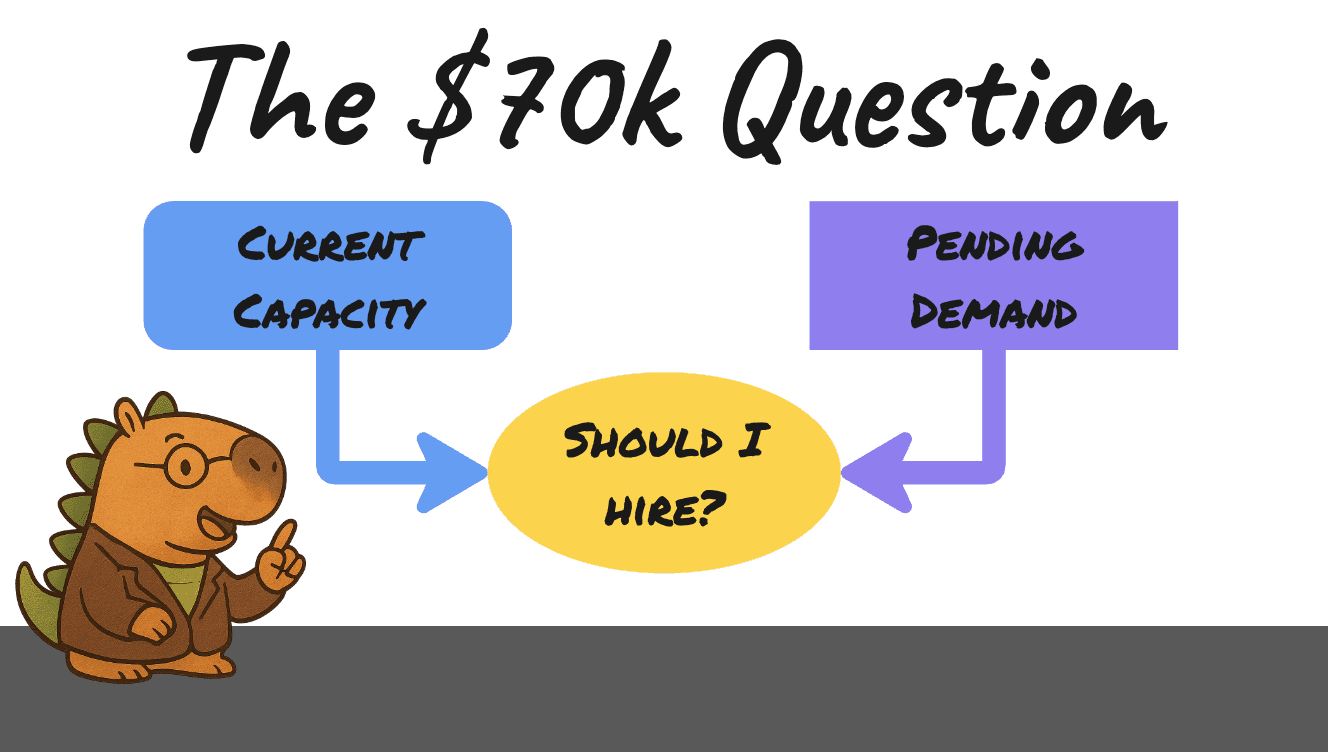
Every growing agency hits the same fork in the road: things are busy, the team is stretched, and you need to expand capacity somehow. Do you buy better tools? Hire more people? Both?
The wrong choice can cost you months of progress and tens of thousands of dollars.
The Three Types of Bottlenecks
Before you can solve a capacity problem, you need to identify what kind of bottleneck you have. There are really only three types:
1. Throughput Bottlenecks
You have enough people with the right skills, but manual processes slow everything down.
Signs:
- People spend hours on repetitive tasks
- Work gets stuck waiting for handoffs
- Quality inconsistency despite skilled staff
- "We could do more if we didn't have to..."
Solution: Tools and automation
2. Capability Bottlenecks
You don't have enough people with specific skills, even if overall headcount is fine.
Signs:
- One person is always the blocker
- Certain project types can't be done
- Skills gaps limit what you can sell
- You turn down work you want to take
Solution: Hiring (or upskilling)
3. Pure Capacity Bottlenecks
You have the skills and the processes, just not enough hands.
Signs:
- Everyone is genuinely busy with valuable work
- Processes are efficient but maxed out
- You're turning down good work
- Team is healthy but fully booked
Solution: Hiring
| Bottleneck | What it looks like | Solution |
|---|---|---|
| Throughput | Enough skilled people, but manual processes slow everything down | Tools and automation |
| Capability | Not enough people with a specific skill, even if headcount is fine | Hiring or upskilling |
| Pure capacity | Right skills and efficient processes, just not enough hands | Hiring, carefully |
The Decision Framework
Once you've identified your bottleneck type, the decision becomes clearer:
If Throughput: Tools First
Throughput problems are often solvable with technology. Ask:
- Can we automate the repetitive parts?
- Can better software reduce handoff friction?
- Can templates standardize the routine work?
ROI math: If a $200/month tool saves 10 hours/week across the team, that's $5,000+ in recovered capacity per month. Much cheaper than hiring.
Warning signs you're wrong: If you buy tools and people are still overloaded, you misdiagnosed the problem.
If Capability: Hire Strategically
Capability gaps require people. But not just any people - the right people.
Questions to ask:
- What specific skill is missing?
- Could existing staff learn it? (cheaper, but slower)
- Is this a full-time need or project-based? (consider contractors)
- Will this capability unlock new revenue?
ROI math: A $80K hire that unlocks $200K in new project types is a clear win. But a $80K hire that does work you could have trained someone for is waste.
Warning signs you're wrong: If the new hire is waiting for work within six months, you overestimated the need.
If Pure Capacity: Hire Carefully
Pure capacity problems mean you need more of what you already have. This sounds simple, but it's where agencies most often over-hire.
Questions to ask:
- Is the demand consistent or spiking?
- Are we at capacity, or are we inefficient?
- What happens if a big client leaves?
- Can we raise prices instead of hiring?
ROI math: A hire has to generate revenue equal to at least 3x their fully-loaded cost. If you're hiring to handle overflow, make sure that overflow is permanent, not seasonal.
Warning signs you're wrong: If you're hiring because you're "too busy" but can't point to specific revenue the new hire will enable, pause and look deeper.
The Hybrid Approach
In practice, the answer is often "both, sequentially."
A common pattern:
- You're overwhelmed (feels like capacity problem)
- You buy tools to improve efficiency (addresses throughput)
- Some of the pressure releases
- You see the real constraint: a capability gap
- You hire strategically for that capability
- Now the tools amplify the new hire's impact
Starting with tools first often reveals what the real problem is. Starting with hiring first often just means you have more people struggling with the same inefficiencies.
The Spreadsheet Test
Here's a simple exercise. List your team's top 10 time sinks:
| Task | Hours/Week | Skill Required | Automatable? |
|---|---|---|---|
| Client reporting | 8 | Low | Yes |
| Asset resizing | 5 | Medium | Partially |
| Email management | 10 | None | Yes |
| Creative direction | 15 | High | No |
| Code reviews | 6 | High | No |
Now categorize:
- Automatable + Low skill = Buy tools
- Not automatable + High skill = Hire or upskill
- Everything else = Depends on volume
This usually makes the answer obvious. If your top time sinks are low-skill and automatable, tools first. If they're high-skill and human-dependent, hiring.
The Budget Reality
Let's be honest: most agencies ask this question because they can't afford both.
If budget is the constraint:
- $1K-5K/month available: Tools only. Maximize automation.
- $5K-10K/month available: Tools first, then consider part-time/contract help for capability gaps
- $10K+/month available: Strategic hiring becomes viable, but still do the bottleneck analysis first
Remember: a tool that costs $500/month and saves 20 hours is equivalent to an $1,250/month part-time hire (at $62.50/hour). Tools often have better unit economics.
The Wrong Reasons to Hire
Finally, some reasons to hire that sound good but usually aren't:
- "We're just really busy right now" (might be temporary)
- "Everyone else at our size has more people" (vanity metric)
- "This person applied and seems great" (solution seeking problem)
- "We need someone to handle overflow" (overflow isn't a job)
The right reason to hire: "We have identified a persistent capability or capacity gap that will directly enable revenue growth, and we've already optimized our processes."
That's a mouthful. But it's the truth.
Quick answers
Should a growing agency buy tools or hire people?
It depends on which of three bottlenecks you have. A throughput bottleneck - enough skilled people but manual processes slowing them down - is usually solved with tools and automation. A capability bottleneck (missing a specific skill) or a pure capacity bottleneck (right skills and processes, just not enough hands) calls for hiring or upskilling instead. Identify the bottleneck type first, and the choice gets much clearer.
When should an agency invest in tools instead of hiring?
When the constraint is throughput: repetitive manual work, handoff friction, and tasks that are low-skill and automatable. The unit economics usually favor software - a $200/month tool that saves 10 hours a week across the team recovers more than $5,000 of capacity a month, far cheaper than a hire. Starting with tools first also tends to reveal what the real constraint actually is.
What's the right reason to hire?
A persistent capability or capacity gap that will directly enable revenue growth, on processes you've already optimized. Hiring because you're "just really busy," because peers your size have more people, or to "handle overflow" tends to backfire, since overflow isn't a job and busy can be temporary. A hire should generate revenue worth at least three times their fully-loaded cost.
Need help identifying your real bottleneck? Try Capysaurus to see exactly where your team's capacity is going.